
Being bored
Or is that just a new way of saying mindfulness?
In 2023, I was talking to cricket writer Siddhartha Vaidyanathan (SidVee) on his love of test cricket. He told me one thing that stuck with me1:
I fear that (with on-demand stimulus) the younger generation will lose the ability to be bored. I think it’s important to be bored, to have that empty space for random ideas and connections to form in your head. When I was growing up, I’d savour the few cricket magazines I got, byhearting scorecards and finding out patterns on my own, forming my own theories.
I never really heard ‘bored’ be used in a positive way like that. At least, I didn’t think that’s where it would come in a conversation around Test cricket’s relevance in the T20 era.
The next year, I was evaluating how to structure a professional life that involved balancing a consultancy, The 6% Club, and a university teaching job. A friend who knows me well gave me the following advice:
You need to find time to do nothing, and just be bored. No agenda. Some of your best ideas have come when you’re bored.
That word again.
A word that would continue Baader-Meinhofing me during The 6% Club sessions, where we espoused frequent reflection. Many people we interviewed for our To Your Heart’s Content series would talk about boredom. Most notably, Abish Mathew spoke about how he deliberately seeks boredom (start at 1:06:04):
Clearly, boredom is having a moment. I’ve heard its virtues being extolled on podcasts, this TED talk, the Veritaserum video Abish references, publications as diverse as VICE and Harvard Business Review, and Reddit. GenZ is ‘rawdogging’ flights and some meditation / nature retreats use boredom as a USP!
When did boredom become a good thing?
Growing up pre-internet, boredom was undesireable. It signalled no cartoons on TV, a long maths class, a weekend morning with the same comic books, being dragged along to a social situation where you’d be alone…
The Veritaserum video adds the nuance needed for today’s context:
Boredom is not when you have absolutely nothing to do. It’s when the options available to you don’t appeal to you. It’s a state of being underwhelmed. And there are now more ways than ever to avoid boredom.
Today, boredom is less “I have nothing to do” and more “I want to give my brain time to rest”. A state of not being always on / learning / evaluating.
It’s clear why this is aspirational now: A reaction to an always-on life, relentless stimuli, and #hustleculture. The best fitness trainers will encourage you to NOT work out everyday - the body needs rest to recover. Boredom could be considered ‘recovery time’ for the brain2.
It’s also accessible3. Unlike a meditation app or a retreat, being bored by nature requires nothing, costs nothing, needs no training4. It’s the easiest, if not purest, form of disconnection.
The irony of all this - and here’s where hustlebros and pure disconnectors both will feel conflicted - being bored is a terrific way to get productive. Just like the workout the day after recovery is killer, giving your brain rest makes you more creative, infuses new life into old ideas, makes you join dots that matter, and so on. It’s the age-old short-term vs long-term tension at play, neurologically this time.
Practically put, do you turn off a bit of work to just read for leisure? Do you willingly not listen to a podcast while doing the dishes? Do you re-watch an old documentary rather than watch a new one to bump up the ‘watched’ list by one? Do you stay up a little while more to finish that book? These are not easy tensions to navigate as both situations have their merits - but I think the more one listens to their body and mind, the more you know which direction to go in that situation.
Abish’s interview is a good place to start. In it, he speaks about letting a good idea deliberately go, training his own mind. If an idea is really good, it will eventually resurface. I also think it’s good training for your brain and taste - only a really good idea is worth moving for.
I, for one, can definitely attest to the therapeutic and medium-term productivity benefits of boredom - in its current definition of giving your brain a rest. I recently wrote about how moving from ‘evaluation state’ to ‘enjoyment state’ changed my relationship with music. I am pretty comfortable not pumping ‘content’ into my eyes and ears every time. I’m more spontaneous with a few decisions. I don’t overcalendarise despite my reputation for doing so. All this really does help. If nothing, I’m sleeping better and that’s a good measure.
One observation fascinates me. Remember how the Veritaserum quote ended with “And there are now more ways than ever to avoid boredom”? So theoretically, the endless stream of social media and content should ensure you’re never bored. But instead, THAT made us more ‘bored’ in the traditional negative sense, more than before.
Turns out, there can be too much of a good thing.
Maybe there’s something around capacity or keeping dopamine up all the time? Like how your taste buds will probably disintegrate if you eat only spicy food? Maybe you need to have sufficient moments of low dopamine to ensure that when you finally get it, it’s actually meaningful?
Some neuroscience or philosophy may hold the answers.
The easiest way to start being bored
Firstly, let me acknowledge how ridiculous it feels to even write that.
The 15-year old me who first got access to the internet wouldn’t have ever thought things would reach a point where we had to search for “how to be bored”.
I know it seems ridiculous to write that but really, how does one start? Do you carve out 30 minutes of “do nothing” time every day? That could work for some, but I feel trying to calendarise something that should inherently not be looked at as productivity is futile.
Instead, I think a good way to start is consciously not productify some activities you already do anyway. Switch off the radio when driving. Don’t do podcasts for one hike. Don’t listen to music when working out5. Limit your input when you have the choice to.
Soon, you may be able to extend this to idle time - when you need a break from work, go to the loo, stand in line… See what not reaching for your phone here looks like. This is tough, but I’ve found it to be very rewarding.
This will help you get to the heart of ‘boredom’ - the feeling of being comfortable in your own head. Talk to yourself6. And once you’ve got that, the final stage may be to not think of any thoughts at all. And this is difficult - as someone who’s had perpetual sleep battles and anxiety-by-overthinking knows.
I’m Feeling Lucky
I think there’s another, more important angle to being bored - taking a chance. Your taste and internal algorithm get sharpened when you subject them to new experiences. There is a good chance you may be disappointed, but also a chance you’ll discover something completely new - which will give you way more satisfaction (and taste built) than something resembling your mean.
In other words, “I’m feeling lucky” over “People who watched this also watched”.
I was thinking of this in the context of stress-testing my own musical taste, when I came across this excellent paragraph written by Ria Chopra from her wonderful new book, Never Logged Out.
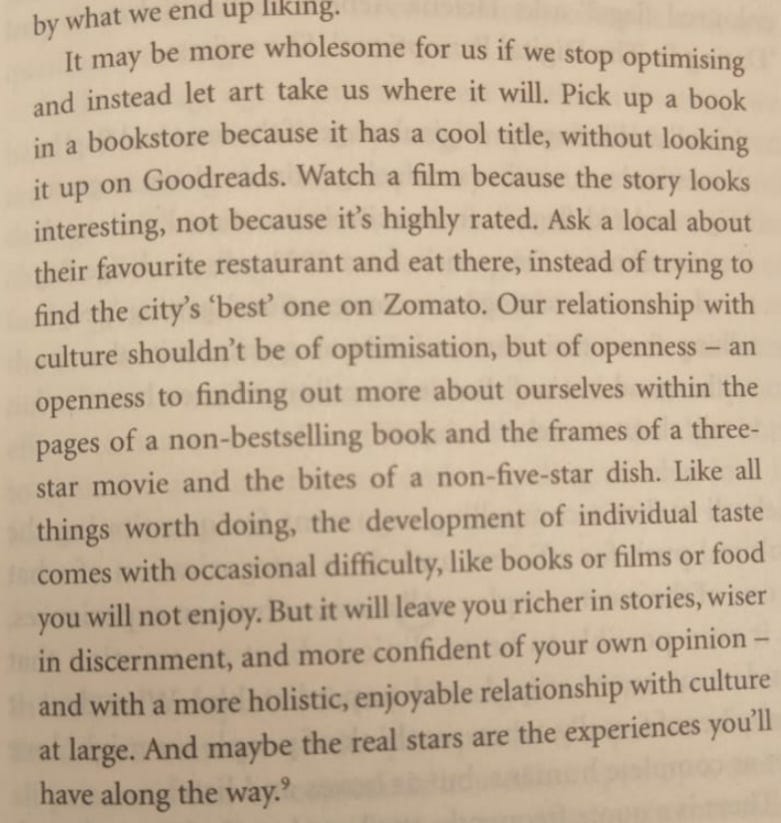
Stop optimising seems like a decent way to ‘get bored’.
So yeah, take a chance on music, movies, restaurants, or even your own idea of leisure.
Last week, I was in Bangalore on work and stayed close to Cubbon Park. I’d never visited it before so was looking forward to a nice 2 hour walk in that urban oasis. After disembarking from my auto (Namma Yatri FTW), I realised in shock I’d left my earphones at the hotel. Oh no - two hours of podcasts I was looking forward to. Now I’d have to just… walk! How… boring?
It turned out to be an amazing two hours. I observed trees and was in awe of their magnificence. Thoughts of how this beautiful place survives being in the middle of the city. Wondered what the stories of all the people visiting were - that lone uncle stretching, that couple sneaking a clandestine date before college, that urbane duo walking their dogs, the cleaning ladies having a laugh, that businessman reading on his phone, that Athlos model seriously in the zone training… I gotta say, those two hours left my head feeling totally relaxed.

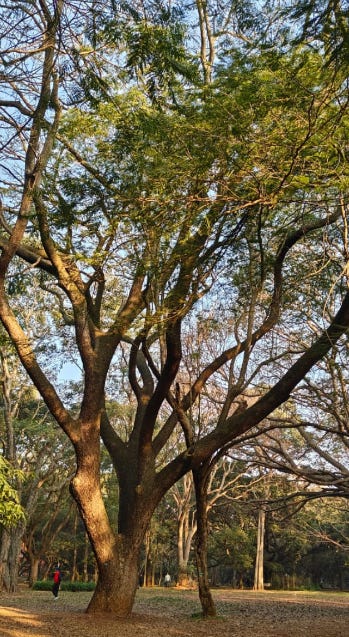
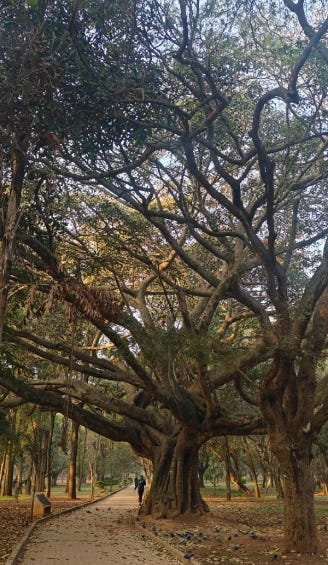
I should forget earphones more often.
Epilogue
SidVee and I spoke about Test cricket and why people still watched it in the day of T20. A beautiful answer he gave me was - it becomes a canvas for their own lives. A spectrum of five whole days to look within themselves.
The amount of time and energy you invest - sometimes for a disappointing result or even no result at all - makes you question many things. About your fandom, about your love for the game, and about your life! You get a Whatsapp ping about a crucial moment when you’re in the middle of a boring meeting and that makes you wonder why on earth you’re in this dead-end job. Someone I know even decided during a match that he would end his marriage that was going nowhere. Test cricket does that to you - it’s very meditative.
I hope you have a nice weekend, but are bored for some part of it.
Chuck
Heavily paraphrasing
A grand statement, but thankfully one confirmed by doctors and neuroscientists,
What a time we live in, when writing “boredom is accessible” actually is something I write, and HBR has a title called “You Need to Be Bored. Here’s Why.”
Privilege check: I realise this is easier for some. A quiet home, or the ability to go to a retreat obviously helps with boredom, and many may be in jobs where the brain needs to function constantly. But broadly speaking - and certainly for readers of this newsletter - boredom is accessible.
I think this also helps immersing in the primary activity fully. I know that I’ve ended up working out better when I am not listening to music or podcasts at all. I can feel my heart rate, regulate movement better, and so on.
Ideally not audibly, at least in public.
I wrote yesterday on the same topic. It's beautiful, almost serendipitious to find another perspective on it - and so well articulated.
Loved it