
Everyone hates a different AI
And some more lessons from history
Maybe one way to gauge how disruptive an idea is, is to look at how diverse its opposition is.
Like when the North American Free Trade Agreement (NAFTA) was discussed in the early 90s, it faced opposition from “a strange coalition composed of organized labor, environmentalists, the radical right, the protectionist left, and some very specific powerful business groups, such as big sugar firms, citrus growers, and the flat-glass industry.”
Bonus points may be awarded if the factions consist of ideologically opposite members. In the 1980s, the rise of pornography united feminists and conservatives, approaching the same problem from two different sets of values. More strange bedfellows can be found in the world of fiction, like when X-Men and Magneto put aside their differences to fight the Purifiers1.
Finding opposing factions is fun. Like when fans of bitter rivals would come together to cheer against Argentina in the recent World Cup (or the club equivalent with a beautiful acronym, ABU).
But the prize for this competition should go to the Janata Party, a coalition of Indian political parties in the late 70s who probably never wanted to be under the same roof2, banding together to usurp Indira Gandhi after the Emergency. Alas, having a common enemy is one thing but finding a common way of working completely another - as the alliance would crumble and face a landslide loss in three years.
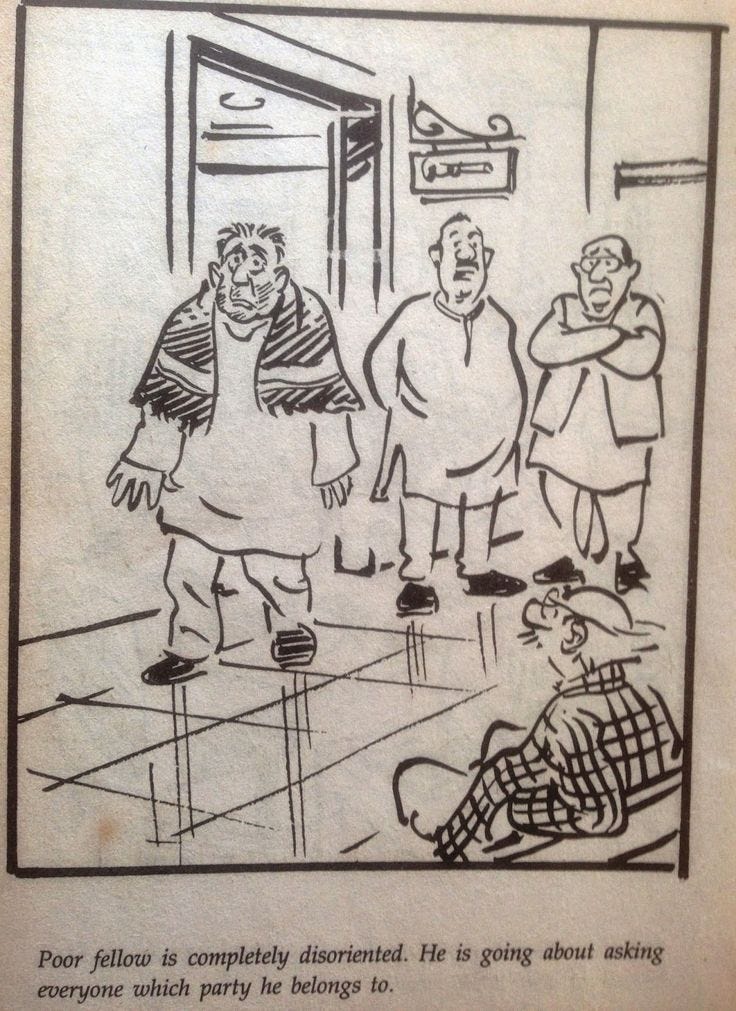
Anyway, all this looking back to history is to try and make sense of the current “coalition” who opposes AI. It’s honestly quite impressive, the sheer range of folks who hate AI for different reasons. If Sam Altman has another molotov cocktail thrown at his house, he may have to stop to ask who the hurler was. It could be any one of:
Environmentalists who believe AI is using up all the water and natural resources
Artists and creative folk who believe AI art is soulless at best, and an existential threat at worst
Journalists and creators of content that AI steals, sorry, trains on for free
Junior workers who worry about AI taking their jobs
Senior workers who’re fed up of cleaning up AI’s mess and complying with “use AI or die” diktats from upper management
Upper management worrying about whether their company will be around tomorrow thanks to AI and wishing it would all just go away
All knowledge workers who’ve gotten the fear of god put into them that AI will upend everything; and just tired of having AI features shoved into their faces (no Google, I do not want to beautify this slide or change my clunky sentence - take your purple underlines where the sun don’t shine and ffs bring back Reader).

Academics who’re fed up of students using AI for homework, or just wondering how to deal with the whole damn thing
Parents already freaking out about social media and screen time, worrying whether this is going to further atrophy their kids’ skills
Women worrying about deepfakes and revenge porn
Americans across party lines opposing data centres being built in their area for a variety of reasons - who would have thought big ugly buildings with NVidia chips is what would finally unite red and blue states?
Financial analysts and traders who worry about a bubble
Regulators - if not governments - seeing fresh hell with every update
The Pope
The average person on the street who now sees Big Tech’s charming male leaders as megalomaniacal egocentric billionaires (which, I will agree is unfair - one of them is a megalomaniacal egocentric trillionaire)
And everyone else just pissed off with AI slop in their feeds, LinkedIn, marketing communication, heck even Tinder chats.
It’s quite impressive that AI has managed to garner so much varied opposition. I don’t mean all of this in a necessarily derogatory way - like I said up top, a new technology will always be met with some opposition, and maybe it speaks to how (potentially positive) the disruption is, that so many different factions are freaking out.
What does all this mean, though?
In a good recent post on his Substack, economist Paul Krugman bluntly answered why everyone hates AI: The companies building it told us it would do terrible things, people feel it’s being forced on them, datacentres are a visible reminder of AI’s (many kinds of) costs, and tech companies & their bosses in general have had a soured reputation even pre-AI.
In my view, a few things, as society learns to grapple with the most transformative technology it’s seen in a while (sorry web3 stans):
The issues raised are now in public consciousness, and will not go away in a hurry
I think it’s important to separate out the underlying issue / concern / fear, from the technology itself. My guess is entry-level workers don’t hate AI in the abstract, but worry about what it will do to their jobs. Creatives worry what happens to art when authorship becomes murky, and human work becomes harder to value. Both of these are important issues that have existed before AI, and will continue even if ChatGPT and its ilk vanish (or likely, are heavily regulated) tomorrow.
An instructive example is the NAFTA one I shared above. Though the ‘strange coalition’ technically lost (the agreement came into force in 1994), the issues it raised - labour rights, environmental enforcement, sovereignty and offshoring - never disappeared from the politics of trade and remain alive to this day, even as NAFTA itself was replaced.
The same is likely to happen with AI. Even if the current boom subsides, the arguments it has forced into the open may produce useful changes. Universities are already having to reconsider what students should learn when passable answers can be generated in seconds and nobody knows what jobs will be available in 2 years’ time. Artists, publishers and audiences are being forced to think about provenance and the value of human-made work. The good thing AI has done from the perspective of those opposing it - is that these questions are now becoming harder to delay.
The ‘coalition’ is larger than the sum of its parts, making it tougher to beat, and easier to hate the enemy
The people in that list of bullet points above are not constituents of a single unified party. But what it does do, is create a compounding aggregating effect: Just as you read about AI taking away jobs in the business papers, you hear your favourite musician lament about a different aspect of it on her Reel. Then you want to order a pizza to distract yourself, but all the restaurants are now using AI-generated images on Zomato and you can’t trust any of them. All this makes it easier for you to say: I hate AI - it’s a convenient acronym that captures so much. From Big Tech’s point of view, solving one faction’s problems won’t make the others go away.
While the disaggregated nature of the opposition does have the disadvantage of not being able to organise together into a clean pithy party, its advantage is that that these issues will be debated for a long time: and solving one does not make the others disappear.
Big Tech needs social solutions and not technical ones
It has never been more apparent how much these large technology firms need people with humanities degrees or, at the very least, social skills beyond mansplaining.
The issues raised by all those groups above are not going to be solved with token efficiency, quicker answers or easier paths to vibe-coding your dream app. Tech firms seem to think that all of society’s problems will go away if they could just be permitted to build more data centres. Hot take, but I think one public meeting with an artists’ group or educators’ collective would do more good than adding more parameters or whatever goes under the hood. Of course, they can’t do that, since it may stall progress and the only way for these firms to dig themselves out of this multi-billion-dollar hole they’ve dug themselves into is to throw caution to the wind and hope some day some graph will flip.
Still, as I propounded before in my Theory of Just Good Enough, maybe tech doesn’t need to break its pretty head trying to build an even more ‘impressive’ version of the LLMs - just work with what they have now and get someone who understands the above communities, seeing them as stakeholders rather than irritants.
A decent example from history is Samsø island in Denmark. In 1997, it was selected to become Denmark’s “renewable-energy island.” The residents’ initial response was mostly indifference and scepticism. In came local teacher Søren Hermansen - he spent years turning up at village meetings, recruiting people whom the community already trusted, translating the project into local rather than planetary terms, got residents shares in the turbines, and well, he brought beer too which helped. By 2003, Samsø was exporting electricity and by 2005, it was producing more renewable energy than it consumed. How many consultations has Big Tech undertaken? Do they take any feedback apart from coders complaining about tokens on X? Have data centres tried communicating how local economies will benefit? Sure, they may have, but what makes the headlines is Altman and Amodei talking about a white collar job apocalypse. Again, some humanities training would help…
Look, maybe AI will end up being a net positive.
Maybe even those creative folks who’re disgruntled with it now will find things to do with it (they may find AI slop has led to an appreciation for actual human craft!).
Maybe it will solve cancer and global warming, and having techbros use GPT fiction on LinkedIn will seem like a small price to pay.
Maybe ugly data centres will eventually morph into places of public art if we can get Bjarke Ingels involved.

My hope is that even if the current moment feels like a heck of a lot of flux, even though everyone hates a different AI, it’ll lead to some long-standing issues being addressed, if not solved.
If AI is here just to help us get commercially feasible nuclear fusion energy, and have a better answer to what it means to be human, I’m down for that.
I will admit, I needed ChatGPT’s help for this reference. I am not a comics nerd.
The Sangh and the leftists in one room? No wonder RK Laxman never ran out of things to draw about.
I read the list in John Oliver's voice in my head 🙃
All fair points Chuck, but I don't see how we can have deep tech in the same room as the other folks. Because the thing about AI is: In its current form, it is built by a small subset of people who only care about increasing shareholder value. As long that value involves can be attained by building myths about the supposed powers of Fable, I don't see any incentive for them to do the hard work of building consensus with those on the other side of the table. Unless we have an effective GenZ style protest against tech somehow and twist their ear. Like you pointed out, since everyone hates a different part of AI, I don't know how these folks will band together, if at all. As always, great food for thought: Here's hoping! :D